Showing posts with label projects-architecture. Show all posts

Thursday, February 21, 2013

Playground, chapter 3 - slide

playground slide
Anna and I are building a farm-themed playground in a cartoon world, and this playhouse is the latest development. The landscape was created earlier. In the next stage, we'll build the other pieces of equipment.

studio rendering
To design this structure, we studied playgrounds, barns, Seussian architecture, roofing, weather vanes, owls, hex signs, and face cut-outs.

render layers
The playground scene is so immense now, that it has to be divided into 4 render layers (above), then reassembled in post (below). Otherwise, the computer can't handle it.

composite graph, "beauty" part
next: seesaw
Related Posts Plugin for WordPress, Blogger...

Wednesday, May 26, 2010

Hotel Righi video, part 7 - the end?

(The Hotel Righi [ree-gee] project was a set of renderings I collaborated on back in 2007. Now that I have some free time, I'm turning it into a short fly-through video.)

assorted frames
(click to view full-res)

This project was suspended a few months ago due to lack of hardware resources, and I've been working on other stuff since. Continuing Righi will require the purchase of a more hefty computer, which I'm not ready to do; so it might be some time before I'm able to return to this project, or I might never return to it.

Here at the halfway/end-point of the project, I wanted to compile what I've completed so far, so there's a semi-satisfying conclusion. The video is composed of low-quality (i.e., fast renders) test frames from various production stages, so it jumps, flickers, swims, and shimmers.

Uncompleted stages include ...
  • low-altitude detailing of roads, buildings, and landscaping
  • animated cars, people, birds, butterflies, and a trolley
  • and the camera animation needs to be smoothed out
  • and the foreground clouds should probably be re-sculpted. They look a little cartoony

 
progress video from project halfway point
Related Posts Plugin for WordPress, Blogger...

Sunday, April 4, 2010

Hotel Righi video, part 6 - landscaping

(The Hotel Righi [ree-gee] project was a set of renderings I collaborated on back in 2007. Now that I have some free time, I'm turning it into a short fly-through video.)

Glion + trees

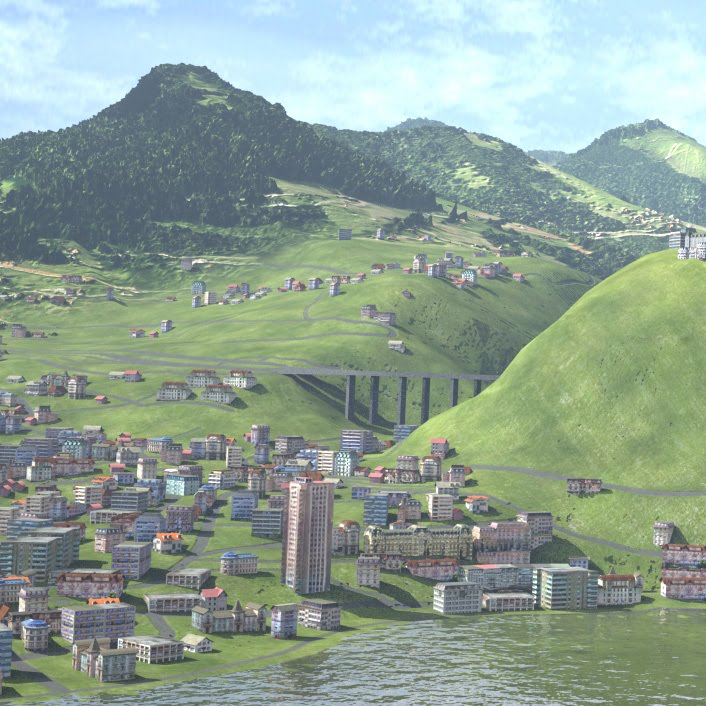
By using a scatter system, I was able to paint trees across the terrain in an afternoon. Without the scatter system, it would have taken many days to place these thousands of trees, and the file size and memory requirement would have become unwieldy.

one low-poly tree

For distances between a few hundred feet and a mile, I scattered 14,500 low-poly trees. Each tree consists of 2000 triangles, which might seem like a lot, but a typical close-proximity tree model can have 200,000+ triangles.

I abandoned the goal of creating a level-of-detail system - which swaps high and low meshes depending on camera distance - as it didn't seem necessary.

frame 685, model
(click to enlarge)

frame 685, render
(click to enlarge)

All the vast, faraway components are in place and 90% finalized. The remaining stages take place within the newly-modeled, ridge-top village of Glion.

next: details, details
Related Posts Plugin for WordPress, Blogger...

Wednesday, March 24, 2010

Hotel Righi video, part 5 - low-poly buildings

(The Hotel Righi [ree-gee] project was a set of renderings I collaborated on back in 2007. Now that I have some free time, I'm turning it into a short fly-through video.)

quasi-Montreux, Switzerland; frame 581, cropped
(click to enlarge)

quasi-Glion, frame 794

 These low-mesh buildings, ranging from 5 to 120 polygons each, were developed for camera distances between a quarter of a mile and a mile.

 mesh & texture files

For ease of production, one texture file contains all of the building photos. Most of the maps were captured by snapping pictures of Montreux and Glion in Google street view, so that the towns might have some similarity to the real thing.

next: low-poly trees
Related Posts Plugin for WordPress, Blogger...

Tuesday, February 23, 2010

W Hotel, part 6 - lighting correction for the suite

I've picked up some new rendering techniques, and I've chosen an old W Hotel scene to refine my understanding of them.
Click on any of the images to enlarge.

step 1: lighting & shader adjustment

before & after lighting adjustment

The first thing I did was to calm the artificial light sources, which were overblown and over-saturated (above left).

step 2: conversion to linear workflow

before & after gamma correction

I've recently begun to use a linear workflow, so I converted this scene, as well. For my purposes, linear workflow creates greater lighting distribution - which means the elimination of hot spots and dark corners - and better color accuracy, so the texture colors are less distorted.

step 3: multi-pass assembly


Render passes are used to create post effects, some of which would be time-prohibitive to render directly in the 3D program. They also allow precise adjustments of the separate lighting elements, after you've spent weeks rendering a sequence and don't have time to re-render. I'm still working on my compositing formula. What I've figured out, so far, is represented below.

diffuse pass

The foundation layer is the diffuse pass: the objects' colors and textures, without any lighting effects.

Related Posts Plugin for WordPress, Blogger...

Tuesday, January 12, 2010

Hotel Righi video, part 4 - FX

(The Hotel Righi [ree-gee] project was a set of renderings I collaborated on back in 2007. Now that I have some free time, I'm turning it into a short fly-through video.)

cloud attempts

It took a few tries to get the clouds to look right. The 1st attempt (top left corner) was starting to look okay, but that technique was prohibitive. The next technique took a few tries (2nd, 3rd, 4th). The camera moves quickly through this part, so it's probably not worth dolling up too much. Maybe I'll change my mind toward the end of the project.

ferry rendering, frame 520;
sailboat model

I built two special boats for this project. One is the Lake Geneva ferry that took a day to create. The other is a low-mesh sailboat for scattering around the lake. It took about 15 minutes to model.

Once again, the camera flies by at about the speed of a jet airplane, and the ferry appears as a blur in the video, so it didn't require much detail. Most of the finer detailing will happen around the hotel, when the camera slows to the speed of a bird.

3D rendering (top) & video post effects (bottom)

Now that test frames have been rendered for the entire video, I can begin synching my audio and adjusting my post effects. Each post effect mimics a camera lens and is blur-based.

The motion blur effect blurs any moving object along the line of action. The depth of field effect blurs anything that isn't within a specific distance from the camera. The bloom effect blurs the borders of luminous image areas, so bright areas appear to glow.

next: hundreds of buildings
Related Posts Plugin for WordPress, Blogger...

Monday, December 21, 2009

Hotel Righi video, part 3 - local terrain

(The Hotel Righi [ree-gee] project was a set of renderings I collaborated on back in 2007. Now that I have some free time, I'm turning it into a short fly-through video.)
Montreux terrain, frame 580
(click to enlarge)

The title of this post, "local terrain," refers to parts of the landscape that are within a few thousand feet of the camera, typically a mile or less. Montreux is the lakeside city below the village of Glion. It's never seen up close in this video, so I think I can get away with this simple level of terrain detail, once buildings and trees are scattered on top.

details of bump, displace, & diffuse maps

The mapping of Glion's terrain has required 13 image files so far, including textures and masks. Above are a few of them. The entire terrain (over 1000 sq.miles) has needed about 40 bitmap textures and 10 procedural textures.

photo courtesy of Google car
(click to enlarge)

Accuracy was improved by running up and down the streets of Glion via Google Street View. However, photorealism is impossible for a scene of this scope without thousands of manhours, more advanced software, and a modest render farm.

Glion terrain, frame 840
(click to enlarge)

Most of this plastic, Fisher-Price look will become obscured by buildings and trees in subsequent stages.

next: FX
Related Posts Plugin for WordPress, Blogger...

Thursday, November 26, 2009

Hotel Righi video, part 2 - distant terrain

(The Hotel Righi [ree-gee] project was a set of renderings I collaborated on back in 2007. Now that I have some free time, I'm turning it into a short fly-through video.)

wireframe & rendering

The title of this post, "distant terrain," refers to parts of the landscape that are at least a few thousand feet from the camera, typically a mile or more. It's created using digital elevation models (DEMs) from the public domain. These models are combined, divided, and either simplified or refined depending on camera distance.

sample tree & building masks
(click to enlarge)

The distant terrain currently uses 190 megapixels of greyscale masks to determine where water, trees, and buildings are placed. Lighter areas specify deep water, tall trees, or tall buildings. Darker areas specify shallow water, short trees, or short buildings. The above masks represent the Swiss town of Vuarennes.

progress rendering, frame 208
(click to enlarge)

Here's a sample result. In this frame, the camera is flying northward through les Portes du Soleil and has just crossed the French-Swiss border. In the bottom-right corner are the Swiss towns of Torgon and Vouvry. Ahead is Lake Geneva, or Léman to the French.

next: neighboring terrain
Related Posts Plugin for WordPress, Blogger...

Sunday, October 25, 2009

Astana enhanced, part 18 - final compilation

(Astana was a hurried video project where a camera flies through 1300 acres of property. Now, to answer my question, "what if we'd been given more time," I'm enhancing the entire neighborhood.)

frame 5220 (click to enlarge)

frame 5130 (click to enlarge)

It's finally over.


finished

Here's a shrunk version of the completed video. I learned all kinds of stuff and will use that knowledge to make the Righi video look even better. I wouldn't mind revisiting this in another few years (version 4) and making an HD version. The landscaping and camera work could be more interesting.


UPDATE, Sept. 11, 2010
I finally got around to posting a higher-resolution version, which is probably only evident in fullscreen mode.

higher-res version
Related Posts Plugin for WordPress, Blogger...

Wednesday, September 23, 2009

Hotel Righi video, part 1 - concept

one of the 2007 renderings,

Now that Astana is near completion (80% of frames rendered, compilation completely prepped, DVD authoring prepped), I'm starting a new video project.

Righi (pronounced ree-gee) is a Swiss hotel we worked on 2 years ago. My task was to create 600 square miles of the surrounding landscape: the mountains and trees. The output was a series of still images. I'm revisiting this site to create a short animation - maybe a minute long - of a camera flying over the Alps and into town.

I selected this project for the opportunity of advanced features and techniques: a rolling landscape, an enchanting location, a huge level-of-detail (LOD) system, and high-quality animated characters. Since the camera focuses on a much smaller habitat - a village of a few acres rather than the 55+ city blocks of Astana - it'll be easier to bump the realism up from what was produced for the Astana project.

site photo

This is one of the photos of the project site, collected from the Internet, that I'll use as reference to model the town.

satellite photo from Google Earth

The Swiss village of Glion lies between Lake Geneva and some ski slopes, and is the home of the world's 3rd best hotel management school.

Here are this project's stages:
  1. terrain - create a model of the mountains and texture it with grass and dirt
  2. buildings - The hotel has already been modeled. The rest of the town still needs to be modeled.
  3. camera path - This is the route that the camera takes through the video. It will determine where in the scene additional detail is required.
  4. vegetation - These could potentially be millions of trees. I'll need to build a LOD system in order to render them efficiently.
  5. rendering tests - After the bulk of modeling is completed, I'll have to determine which rendering system to move forward with. My inclination is to avoid GI (global illumination) and instead create an economical ambient lighting system.
  6. environmental effects - I'd like to include voluminous clouds, sparking water, and various lens effects.
  7. street-level details - Once the camera reaches the street, the area around it - maybe a 200 ft. radius - has to have enough detail to be convincing. This will include details that are omitted from the rest of the town, including sidewalks, curbs, and bushes. Any roofs that are too close to the camera might require detailed shingles and chimneys.
  8. animated people - As the camera slows to a stop before the hotel entrance, there will be 3 highly-detailed humans milling about.
  9. rendering, compilation, DVD append
Related Posts Plugin for WordPress, Blogger...

Sunday, July 26, 2009

Astana enhanced, part 17 - rendering progress

(Astana was a hurried video project where a camera flies through 1300 acres of property. Now, to answer my question, "what if we'd been given more time," I'm enhancing the entire neighborhood.)

frame 3276 (click for full-res)

It's months later and the rendering is almost halfway completed. Much of the time was spent figuring out the best settings to eliminate flicker without losing too much rendering speed. Flicker is caused by anti-aliasing, global illumination maps, and shader interpolation, if the settings aren't just right.

resolution comparison
(Each of these details accounts for less
than 1% of the entire screen area.)

After a few early tests, I abandoned my HD-res goal. HD, while beautiful in its degree of detail, can take 8 times as long to render as NTSC, and I simply don't have the computing power to crunch those numbers expeditiously. However, HD is the industry standard, so its hurdles can't be avoided forever.

This project has been valuable instruction for rendering gigantic scenes in a timely manner. I learned - for videos longer than 30 seconds - to render backgrounds and moving objects separately and composite them afterward. This will result in speedier renderings, higher-quality video, and greater control in post.

I also learned - for longer videos - to avoid global illumination (GI). This is particularly obvious in the wake of the HD standard. Two of the goals of my next video project will be GI alternatives and fast HD renders.

Below is a lower-res version of the video so far. This one contains audio, so adjust your speakers if necessary.

approximately 40% of frames completed

Related Posts Plugin for WordPress, Blogger...

Thursday, April 23, 2009

spa

detail from enhanced version

I worked on this spa project last autumn for Shigeru Ban Architects. It ended before lighting could be designed, so I'm now adding lighting to create a composition that I'll be happier with.

rough progress rendering

This was my first submission for the original project: an incomplete progress image.

completed geometry

The rest of the architecture was filled in. The client asked that the camera be pulled back to reveal the skylight, and that the chaos be reduced (see below). Although the cylindrical waterfall was in their design, they felt it dominated the composition; so it was removed.

final commissioned rendering

Lighting was adjusted and people were added. This was the last rendering sent to the client before the project ended.

photo of scale model

Now I finally have time to create an image from this project that I'm a little happier with. Lighting design was never finalized for this room, so I simply appropriated the lighting layout from photos of an early scale model.

my version (click for large)

Here's my revised composition. With all that's going on in this image, it took many days to test-render, render, and then patch-render; so this wouldn't be a practical rendering for the typical small job. Maybe in another 5 years, after the CPU tech has caught up....
Related Posts Plugin for WordPress, Blogger...

Sunday, March 22, 2009

Astana enhanced, part 16 - tower & street lamps

(Astana was a hurried video project where a camera flies through 1300 acres of property. Now, to answer my question, "what if we'd been given more time," I'm enhancing the entire neighborhood.)

[motion-blurred version of] old tower

This tower shows up during one of the flyovers. Again, I'm not an architect, but it needed to be a little more interesting, so I did my best to design a new one. It's possible that my new tower is ugly or ridiculous and I simply don't have the architectural acumen to realize it.

Here's my design sketch....

...And here's the finished new tower.

Next, I want a few street lamps in the foreground of the final frames.

street lamps, test render

oops, too bright

street lamps, final test

Now I just have to render 5540 frames and add audio.
Related Posts Plugin for WordPress, Blogger...

Friday, March 20, 2009

W Washington Hotel, part 5 - suite

(About a year ago, we were contracted to do the illustrations for W Hotel's new Washington D.C. hotel.)

design drawing, by "Zaldi"

My 3D rendering was partially based on this drawing. I didn't make this drawing, and I don't know who the illustrator is, but the signature says "Zaldi."

test rendering 1

This was my first test rendering.

test rendering 2

The first pieces of furniture are modeled.

test rendering 3

After a few days of work, the rest of the furniture has been modeled and mapped.

final rendering (click to enlarge)

The designer managed one redesign (rug, furniture colors, TV, fireplace) before the project had to end.
Related Posts Plugin for WordPress, Blogger...

Wednesday, March 18, 2009

Astana enhanced, part 15 - site G + deer process

(Astana was a hurried video project where a camera flies through 1300 acres of property. Now, to answer my question, "what if we'd been given more time," I'm enhancing the entire neighborhood.)

new version

old version

new version, detail

deer rig (click to enlarge)

deer UV map (click to enlarge)

As usual, dynamics and animation were devised by studying videos. In the 1940's, Disney Studios brought in live animals for the animators to study. Today, we have YouTube, where thousands of animal videos are available.


deer animation test

This is the last site (G) for the Astana project, but I still have a few more weeks of clean-up, animation tests, render processing and audio editing before it's finished.
Related Posts Plugin for WordPress, Blogger...