Tuesday, May 14, 2013

Playground, chapter 4 - seesaw

seesaw, studio renderings
The second piece of equipment that Anna and I built for our farm-themed playground project is called a two-person spring rider. We switched from a seesaw to the current spring rider because a spring is more visually dynamic than a normal fulcrum. We kept the name "seesaw" because it's easier for file & node-naming.

production stages of goat
The image above shows the production stages of the goat ride. First, Anna makes quick sketches to determine which animal might look best. Then she does the technical drawings which are the final design and are also used as modeling guides. Finally, she chooses which colors to apply through a texture map.

seesaw in landscape
next: swing

Tuesday, March 26, 2013

Tobia at Home, revisited

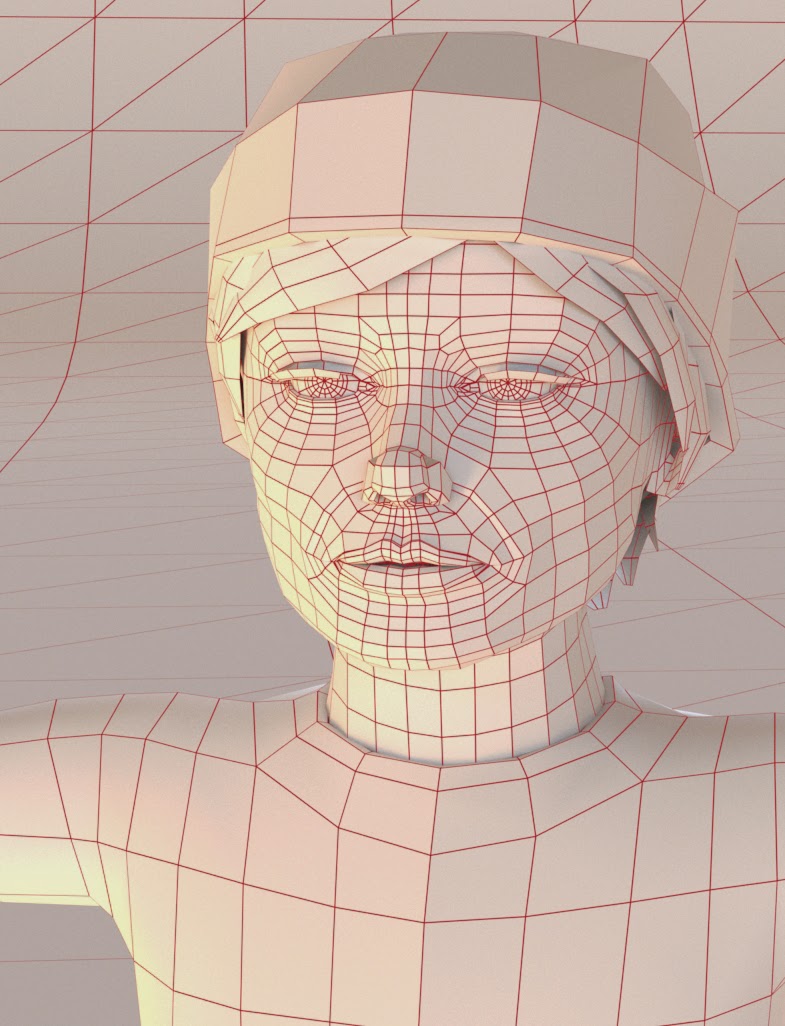
revised Tobia scene: mesh overlay
Reviewing a 2-year-old rendering from the Tobia project - by Anna & me - I determined I could squeeze out one more rendering without too much more work.

old rendering
Here's the previous rendering. There is nothing terribly wrong with it, but I wanted to make a more interesting version.

Most of the old lighting is ambient, resulting in a flattened space.
The dog seems to be under-represented, with much of the focus drifting to the colorful props.

new rendering
In the new image, there's more lighting variation throughout the space, creating improved depth and reflections.
The adjusted camera angle increases the significance of the dog by showing more of its face and tag.
Pronounced surfacing on the back wall helps to make the room more tangible.

Thursday, February 21, 2013

Playground, chapter 3 - slide

playground slide
Anna and I are building a farm-themed playground in a cartoon world, and this playhouse is the latest development. The landscape was created earlier. In the next stage, we'll build the other pieces of equipment.

studio rendering
To design this structure, we studied playgrounds, barns, Seussian architecture, roofing, weather vanes, owls, hex signs, and face cut-outs.

render layers
The playground scene is so immense now, that it has to be divided into 4 render layers (above), then reassembled in post (below). Otherwise, the computer can't handle it.

composite graph, "beauty" part
next: seesaw

Thursday, November 22, 2012

Playground, chapter 2 - landscaping

landscape development
Here's the latest stage of an illustration by Anna and me. (The design process can be seen in the previous chapter.) The landscape is modeled prior to the people and props, because it will require the most time for finessing.

The colorful surfaces near the center of the composition are special child-safe "poured-in-place" rubber floors, commonly made from recycled tires.

detail
With displacement tessellation and all the vegetation, the rendering engine has a hard time handling several million triangles. To keep from hitting my RAM ceiling, I distributed the scene objects into multiple render layers. Background and foreground objects are rendered separately, and recombined in a compositing program. Doing so has cut rendertime RAM requirements and total rendering duration in half.

part of the composite graph
next: slide

Thursday, October 25, 2012

Wonder Warthog, part 11 - hair & fur

(I'm redesigning, modeling, and rigging Gilbert Shelton's classic cartoon character, "Wonder Wart-Hog.")

"flow it, show it"
The modeling of the head is 95% complete, which means I'll continue adjusting it while moving on to other body parts. It still needs to be rigged, but that comes much later. Rigging, in this case, is making the eyes, mouth, and ears moveable, so they can be animated.

history
Whenever you see a detailed painting or sculpture and wonder "how did they do it," the answer is simply hundreds or thousands of hours: planning, researching, designing, modeling, and other gerunds.


dynamics adjustment

The hair and fur are dynamic. This means the hairs will react to forces like gravity, head movement, and other dynamic objects. The above video shows some of the tests used to see if the hair is moving in a natural way.
... Still much to do.

next: hands ✌

Tuesday, October 16, 2012

Playground, chapter 1 - design

design stages
The next project of the Anna-Greg team will culminate in a storybook-style rendering of a playground. On the way there, I'll post renderings of the components.

design
The first step was to choose a design. This involved sketching all our ideas, then picking the favorites.

3D previz
The second step was a 3D pre-visualization process, which was necessary due to the complexity of the scene. With this step, we block out the scene with primitive objects to determine the volumes and how the landscape will we constructed around the fixtures. This is the 3D version of sketching. All the objects in this scene are proxies which will eventually be replaced with more developed designs and models.

next: modeling

Friday, August 24, 2012

Testing the Waters, ep. 7 - shattered

(experiments in fluid dynamics)
smash, splash
This is my first simulation of destruction physics, using rigid-body dynamics.
The bowl was shattered with one of those randomized shattering operations that most 3D programs have. There's the standard particle simulation to fill the unbroken bowl with water. Then separate explosion forces are applied to the shards and fluid. The water's explosion is about 10% the strength of the glass force. It's not strictly realistic, but it has the look I want.


The video shows the process of adjusting the simulation settings, then the final rendering. If you only want to see the final rendering, skip ahead 45 seconds.
If you want so see it in high definition, you'll have to watch it on Vimeo.

Friday, July 20, 2012

Giraffa

finished composite
Here's another product-visualization exercise. The design is by Anna. The rendering is by me. The modeling is by both of us.

design sketches by Anna
Anna's initial goal was to design a rocking giraffe, but she managed to fit 6 other product designs into the scene.

detail
For me, this and the previous project are attempts to bridge the knowledge gap between brightly-lit visualization rendering, and more nuanced illustrative rendering.

Wednesday, May 16, 2012

Tobia at work, part 2

Tobia's pal
This is the final rendering of the Tobia project, a collaboration between Anna Maria Bonanese and myself. The previous post dealt with the construction of the barn and a few props. This one focuses of the design and construction of Tobia's companion.

mouse forms by Anna
The first step in the mouse design was to research photos of mice and their anatomy. From those, Anna produced these sketches. Silhouettes are used in order to resolve the form. The modeling environment is not the place to resolve rudimentary design issues, so we sketch until we're happy with its shape.

spec drawings by Anna
Then Anna designed these modeling guides.

Saturday, December 3, 2011

Tobia at work, part 1

Tobia en garde (click to enlarge)

Tobia recently found employment as a sheepdog. Here, he’s seen preparing for work.

The concept was to use the same model of the plastic toy, and change the textures so it appears as an old discarded toy in an abandoned building. The new composition was conceived of and designed by myself and Tobia-designer, Anna.

 design stages, by Anna and me

early rendering - new scene being built

... and then with some textures applied ...

intermediate rendering, ready for the next stage
(click to enlarge)

next: a friendly visit
Related Posts Plugin for WordPress, Blogger...